 EN
EN

Introduction: why nutrient use efficiency defines modern crop performance
In modern agriculture, nutrient use efficiency has emerged as one of the most important performance indicators for both productivity and sustainability. While crop yields have increased over the past decades, nutrient efficiency has not improved at the same pace. A substantial proportion of applied nutrients—particularly nitrogen—fails to reach the crop, instead being lost to leaching, volatilization, or long-term soil immobilization.
According to peer-reviewed assessments published in Plants (MDPI) and Frontiers in Plant Science, global nitrogen use efficiency in many cropping systems remains below 50%. These losses translate directly into higher production costs, reduced nutrient availability to plants, and increased environmental pressure.
Arginex, a crop nutrition technology developed by Arevo, was designed specifically to address this efficiency gap by improving how nutrients behave in the soil and how effectively plants are able to take them up.
What nutrient use efficiency really means in the field
Nutrient use efficiency (NUE) is often discussed in abstract terms, but for growers it has very practical implications. NUE reflects the proportion of applied nutrients that are actually converted into plant biomass or yield.
Losses typically occur through three main pathways:
-
Leaching, where nutrients move beyond the root zone with water
-
Volatilization, particularly with nitrogen sources under certain conditions
-
Chemical or biological immobilization, where nutrients become unavailable to the crop
Improving NUE does not necessarily require higher application rates. In fact, research increasingly shows that improving nutrient delivery and uptake efficiency often produces better outcomes than increasing nutrient supply.
Scientific evidence for improving nutrient efficiency through delivery systems
A growing body of scientific literature demonstrates that nutrient form, stability, and timing strongly influence uptake efficiency. Studies published in New Phytologist and Plant Cell & Environment have shown that plants can directly absorb organic nitrogen compounds such as amino acids, including under field conditions.
These findings challenge older fertilizer paradigms that treated inorganic nitrogen as the only agronomically relevant form. Instead, they support the development of nutrient delivery systems that are more closely aligned with plant physiological processes.
Arevo has compiled and published a large collection of these studies on its science publications on plant nutrient delivery systems page, including:
-
field studies on organic nitrogen uptake by wheat
-
nitrogen use efficiency improvements linked to organic nitrogen sources
-
reduced nitrogen losses in arginine-based nutrient systems
https://arevo.se/en/science-publications-on-plant-nutrient-delivery-system
These research directly informs the design philosophy behind Arginex.
How Arginex improves nutrient behavior in soil
Activating soil biology through charge-driven nutrient stabilization
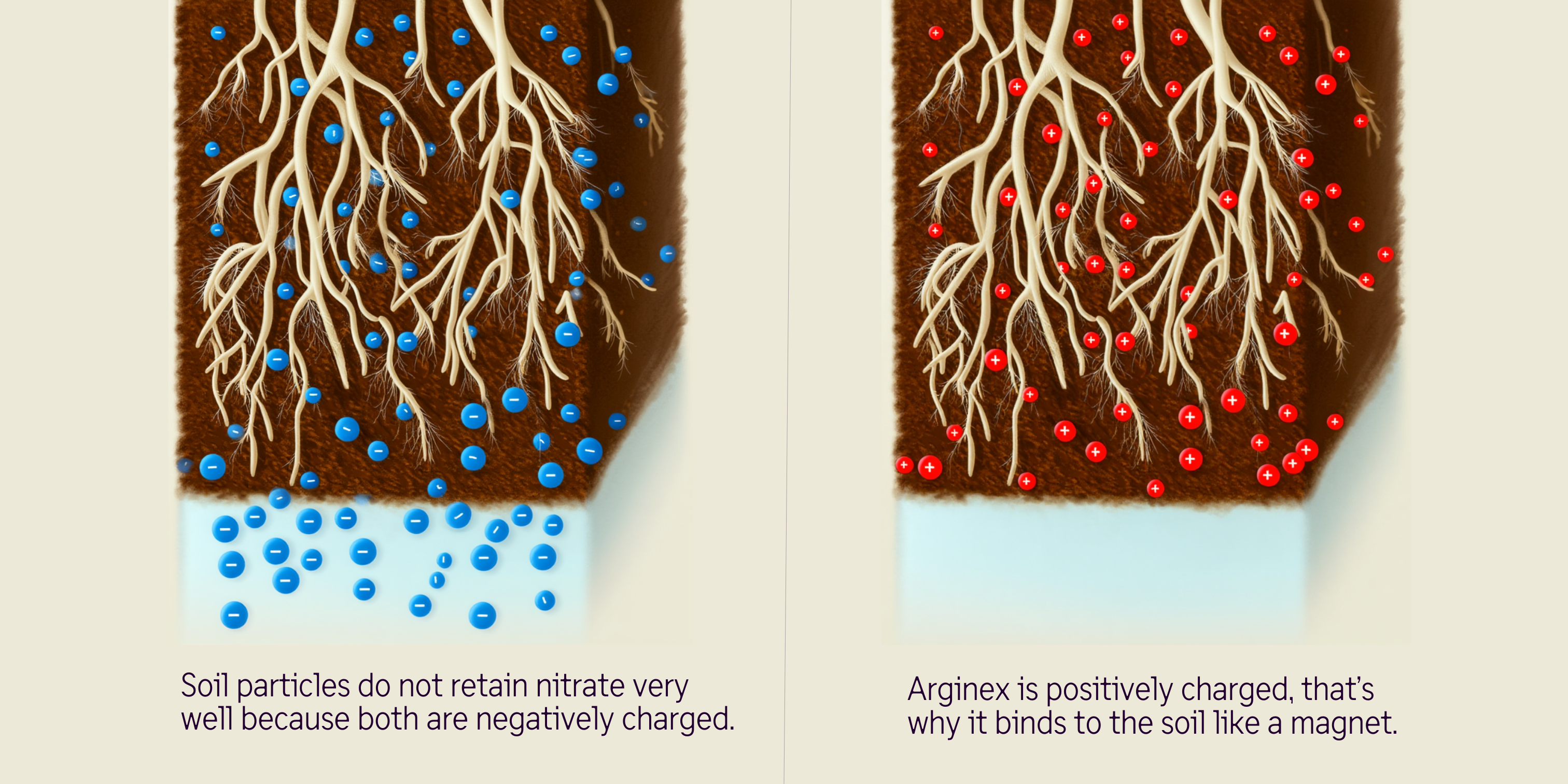
One of the primary causes of low nutrient use efficiency is the rapid movement of soluble nutrients away from the root zone. Conventional mineral nitrogen fertilizers are commonly applied in nitrate form, which carries a negative electrical charge. Because most soil particles—particularly clay minerals and organic matter—also carry a net negative charge, nitrate is poorly retained in soil. As a result, it moves freely with water through the soil profile, making it highly susceptible to leaching during rainfall or irrigation events.
This rapid downward movement not only leads to nutrient loss but also limits meaningful interaction between nutrients, plant roots, and soil microorganisms.
Arginex behaves fundamentally differently. Arginex is based on positively charged (cationic) organic nitrogen structures, meaning it is naturally attracted to the negatively charged surfaces of soil particles. This electrostatic attraction causes Arginex to bind to soil in a magnet-like manner, anchoring nutrients within the biologically active root zone rather than allowing them to move freely with water.
By remaining associated with soil particles, Arginex creates a more stable nutrient environment in the rhizosphere—the narrow zone of soil directly influenced by root activity. This stability increases the residence time of nutrients in close proximity to roots and soil microorganisms, which is a critical prerequisite for efficient uptake and biological processing.
Enhancing microbial interactivity and creating a more active soil
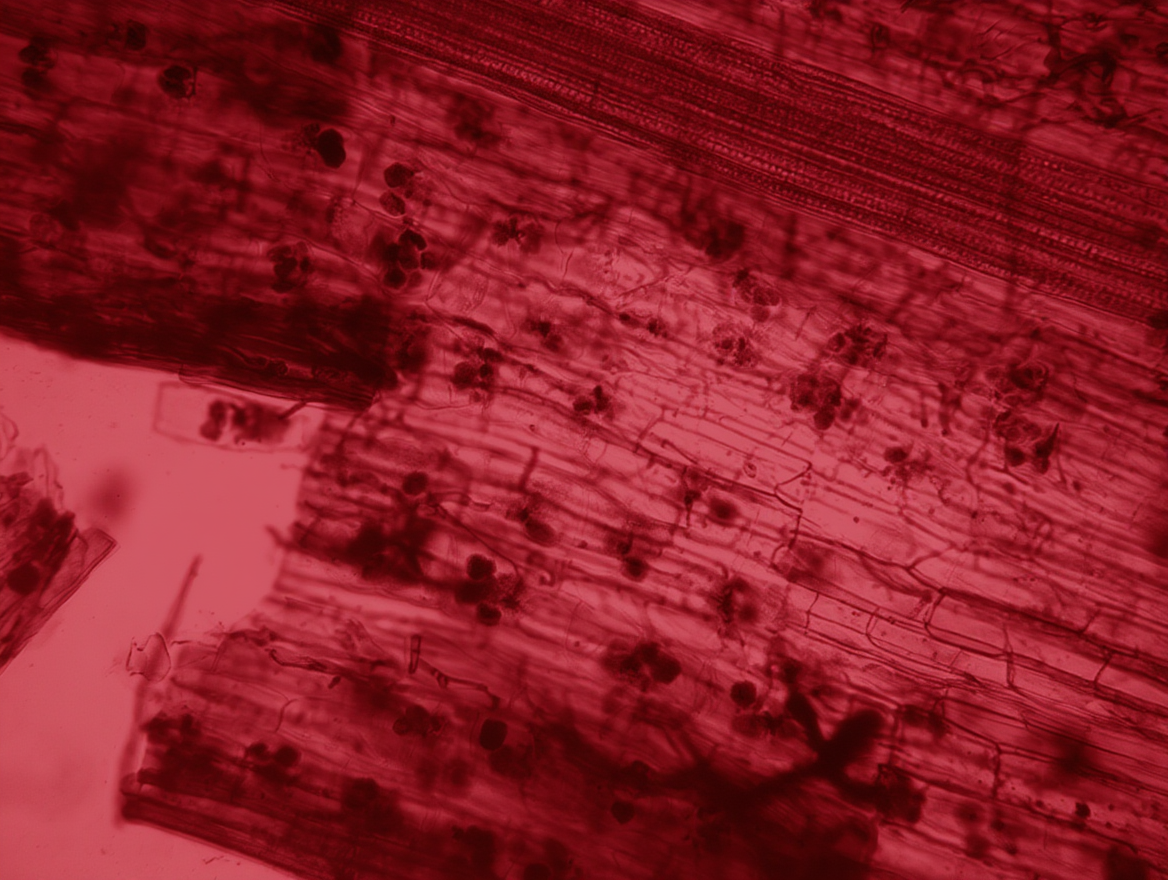
Beyond its physical stabilization, Arginex plays an important role in activating soil biology. Organic nitrogen compounds such as amino acids are not only nutrient sources for plants but also key substrates for soil microorganisms. When nutrients are retained in the rhizosphere through charge-based binding, microbial communities have greater access to them.
This promotes:
-
increased microbial metabolic activity
-
enhanced nutrient cycling through microbial immobilization and release
-
stronger root–microbe signaling and interaction
-
improved synchronization between nutrient availability and plant demand
Research summarized in Arevo’s science publications on plant nutrient delivery systems shows that arginine-based nutrient systems significantly reduce nitrate leaching compared to conventional nitrogen sources. Importantly, this reduction is not achieved by inhibiting biological processes, but by keeping nutrients within biologically active zones, where microbes and roots can interact with them directly.
As microbial activity increases, soil shifts from being a passive medium for nutrient transport to an active biological system that participates in nutrient transformation and delivery.
Supporting on-demand nutrient uptake
Plants do not absorb nutrients continuously or uniformly. Uptake varies according to growth stage, temperature, moisture, and physiological demand. Conventional fertilizers often release nutrients independently of these uptake patterns, increasing the risk of mismatch and loss.
By combining electrostatic soil binding with biologically compatible nutrient forms, Arginex maintains nutrient availability over time rather than in short-lived concentration peaks. This supports better synchronization between nutrient presence in the soil and plant uptake demand, a key determinant of nutrient use efficiency highlighted in Frontiers in Plant Science.
Reducing nutrient loss pathways under challenging conditions
Peer-reviewed studies on arginine–iron–hexametaphosphate complexes demonstrate that stabilizing nitrogen within organic, positively charged complexes significantly reduces nutrient loss pathways while maintaining plant availability. These mechanisms are particularly important in sandy soils and high-rainfall regions, where negatively charged nitrate is most prone to leaching.
By contrast, the cationic nature of Arginex allows nutrients to remain associated with soil and biological systems even under conditions that normally favor nutrient loss.
Why this mechanism matters
This combination of charge-driven soil binding, microbial activation, and biological compatibility distinguishes Arginex from conventional mineral fertilizers. Rather than bypassing soil biology, Arginex leverages it—transforming soil into an active partner in nutrient delivery rather than a passive conduit for nutrient loss.
In doing so, Arginex supports:
-
higher nutrient retention in the root zone
-
more active and resilient soil microbial communities
-
improved nutrient use efficiency
-
reduced environmental losses
This integrated physical–biological mechanism is central to how Arginex functions as a crop nutrition technology, not simply a fertilizer input.
Field-level implications for growers
More consistent crop response
Inconsistent nutrient availability often leads to uneven crop development, especially under variable weather conditions. By improving nutrient stability and uptake efficiency, Arginex supports more uniform plant growth across fields.
This consistency is increasingly important as climate variability introduces greater uncertainty into nutrient management decisions.
Improved return on nutrient investment
From an economic perspective, nutrient efficiency directly affects input return. When a larger proportion of applied nutrients is recovered by the crop, growers benefit from:
-
reduced effective fertilizer cost per unit of yield
-
fewer corrective or supplemental applications
-
improved predictability in nutrient performance
These benefits are widely cited in agronomic efficiency analyses published by FAO and academic institutions.

Environmental outcomes linked to higher nutrient efficiency
Improving nutrient use efficiency is one of the most effective ways to reduce agriculture’s environmental footprint. According to FAO and Frontiers in Plant Science, higher NUE contributes to:
-
reduced nitrate contamination of groundwater
-
lower emissions associated with nitrogen losses
-
improved compliance with environmental regulations
Because Arginex sticks to the soil like a magnet, it doesn't leach regardless of rains. It focuses on nutrient utilization rather than application rate, it aligns productivity goals with environmental stewardship.
Arginex compared to conventional efficiency approaches
| Efficiency approach | Limitation | How Arginex differs |
|---|---|---|
| Higher application rates | Increased losses | Focuses on utilization |
| Split applications | Operational complexity | Improves availability over time |
| Inhibitors | Limited duration | Biology-aware nutrient delivery |
| Precision placement | Equipment dependent | Works within existing programs |
This comparison highlights why Arginex is best understood as a crop nutrition technology platform, not simply an additive or amendment.
Soil health and long-term nutrient dynamics
Long-term nutrient efficiency is closely linked to soil health. Excess mineral fertilization can disrupt microbial communities and contribute to nutrient imbalances over time.
Research published in Plant Physiology and New Phytologist suggests that organic nitrogen sources can support healthier soil-plant interactions by:
-
providing both nitrogen and carbon
-
supporting microbial activity involved in nutrient cycling
-
reducing chemical stress in the rhizosphere
Arginex aligns with these principles by supporting nutrient delivery mechanisms that work within biological systems rather than overriding them.
Why efficiency-focused nutrition will define the future
Global agriculture faces increasing pressure to produce more with fewer resources. Across academic, regulatory, and industry publications, improving nutrient efficiency is consistently identified as a central strategy for sustainable intensification.
Arginex reflects this shift by focusing on:
-
nutrient behavior after application
-
plant-centric uptake mechanisms
-
reduced environmental losses
These attributes position Arginex within the next generation of crop nutrition solutions.
Conclusion: Nutrient efficiency as the core value of Arginex
Arginex was developed to address one of agriculture’s most persistent challenges: low nutrient use efficiency. By improving nutrient stability, uptake timing, and utilization at the root–soil interface, Arginex supports both agronomic performance and environmental responsibility.
As nutrient efficiency becomes a defining metric of modern agriculture, Arginex stands out as a crop nutrition technology developed by Arevo to meet this challenge directly.
References
-
Arevo AB. Science publications on plant nutrient delivery systems.
https://arevo.se/en/science-publications-on-plant-nutrient-delivery-system -
Näsholm, T. et al. Organic nitrogen uptake by plants. New Phytologist.
-
Moran, K. K. et al. The carbon bonus of organic nitrogen enhances nitrogen use efficiency. Plant Cell & Environment, 2016.
-
MDPI Plants. Nitrogen use efficiency in agriculture, 2024.
-
Frontiers in Plant Science. Plant nutrient use efficiency and sustainability, 2024.
-
FAO. Improving nutrient use efficiency in agriculture.