News

Walk through a newly planted forest and you won’t see much difference between trees treated with arGrow and those given traditional fertilizer.
And that’s exactly how it should be.
In their first year, seedlings are fighting for survival. They face frost, drought, wind, and competition from weeds. It’s not the time to chase height — it’s the time to anchor life.
That’s why arGrow trees grow differently.
While conventional fertilizers push for quick results above ground, arGrow helps the tree focus below the surface — where the foundation for a lifetime of growth is made.
The early stage of a tree’s life is when it’s most vulnerable.
The difference between surviving and failing often comes down to what’s happening beneath the soil — in the fine roots and in the microscopic world around them.
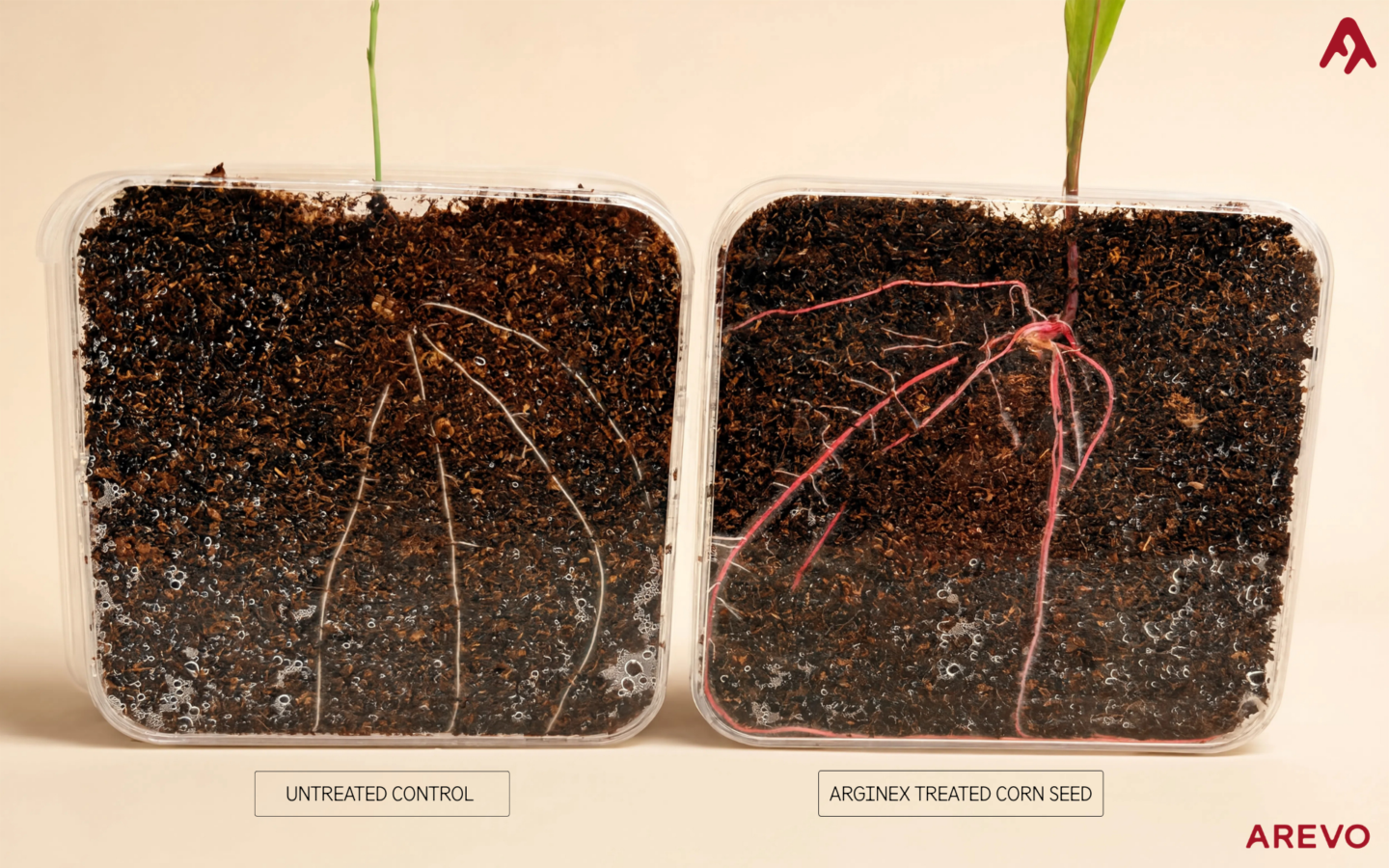
When a seedling receives nitrogen from arginine, the natural amino acid at the core of arGrow, it behaves differently than when fed with nitrate. Instead of chasing rapid height, the plant channels energy into developing roots and mycorrhiza — the network of fungi that help it absorb water and nutrients later on.
This stage isn’t flashy. In Year 1, there may be little visible difference in height between arGrow and control plants.
But underground, the structure is changing. The root system grows denser, stronger, and better equipped to handle stress.
And once that foundation is built, the difference above ground starts to accelerate.

The best evidence of arGrow’s long-term effect comes from the forests of Sweden and Finland.
In Swedish field trials, pine and spruce treated with arGrow reached +39 % higher stem volume after five years compared with untreated controls.
In Finland, spruce saplings grew an average of 38.6 cm per year versus 21.1 cm for control plants — an 83 % improvement.
Silver birch (Rauduskoivu) showed 31 % higher height and 48 % thicker stems after just 18 months.
During the first year, those trees looked ordinary.
By Year 3, the difference became visible.
By Year 5, it was impossible to miss.
Each season built on the previous one — a compounding effect that turned a subtle start into a measurable, long-term advantage.

The explanation comes down to biology and chemistry.
Arginine — the amino acid form of nitrogen in arGrow — behaves differently from nitrate. It’s positively charged, which means it binds to soil particles instead of washing away. This keeps nitrogen available in the root zone longer and reduces losses to nearby water systems.
Inside the plant, arginine acts as a storage and transport form of nitrogen, giving seedlings a slow, steady release of nutrition that matches their natural growth rhythm.
That’s why studies from the Swedish University of Agricultural Sciences (SLU) show 80 % nitrogen uptake efficiency with arginine, compared with about 50 % for mineral fertilizers. Less input. Less leakage. Better growth over time.
Plants that received arGrow developed fine roots significantly faster and were more robust after the first season.”
— Metsuritrio, Finland
These aren’t isolated results. They reflect a pattern seen across hundreds of millions of seedlings in Nordic forests — quiet resilience first, steady compounding growth later.
Forestry isn’t a race to grow the fastest tree.
It’s about giving each one the best chance to survive, adapt, and keep growing decade after decade.
arGrow doesn’t shortcut that process — it strengthens it.
By helping trees build a stronger foundation when they’re most vulnerable, it sets them up for growth that lasts their entire lifetime.
Because the real difference isn’t made in the first year.
It’s made in the years that follow, when strong roots meet the open sky.
References
Featured Knowledge