The nitrogen cycle in soil: what the textbook leaves out

The nitrogen cycle in soil: what the textbook leaves out
You spread nitrogen. The crop takes up about half. The rest goes somewhere you never see and never get paid for. That gap is not bad luck — it is baked into the version of the nitrogen cycle most of us were taught.
What is the nitrogen cycle in soil?
The nitrogen cycle in soil is the set of transformations that shuttle nitrogen between the atmosphere, soil organic matter, microbes, soil water and plant roots. Fixation brings nitrogen in. Mineralisation breaks organic matter down into ammonium. Nitrification converts that ammonium to nitrate. Then plants take up what they can, and leaching, denitrification and volatilisation take the rest. The FAO now publishes cropland nutrient budgets for every country precisely because those flows are large enough to move water quality and climate numbers.
Why does the textbook nitrogen cycle leave out organic nitrogen?
Because for most of the twentieth century, plant science assumed roots could only use mineral nitrogen. The diagram put microbes in the middle as compulsory middlemen: nothing reached a root until bacteria had chopped it down to ammonium or nitrate. That assumption held until researchers showed plants take up intact amino acids directly from soil, bypassing full microbial mineralisation (Näsholm et al., 2009). Schmidt (2014) went further and argued the organic nitrogen pool — not nitrate — is the dominant nitrogen currency in most soils. The textbook did not get the chemistry wrong. It got the plumbing wrong.
How much of the nitrogen you apply actually reaches the crop?
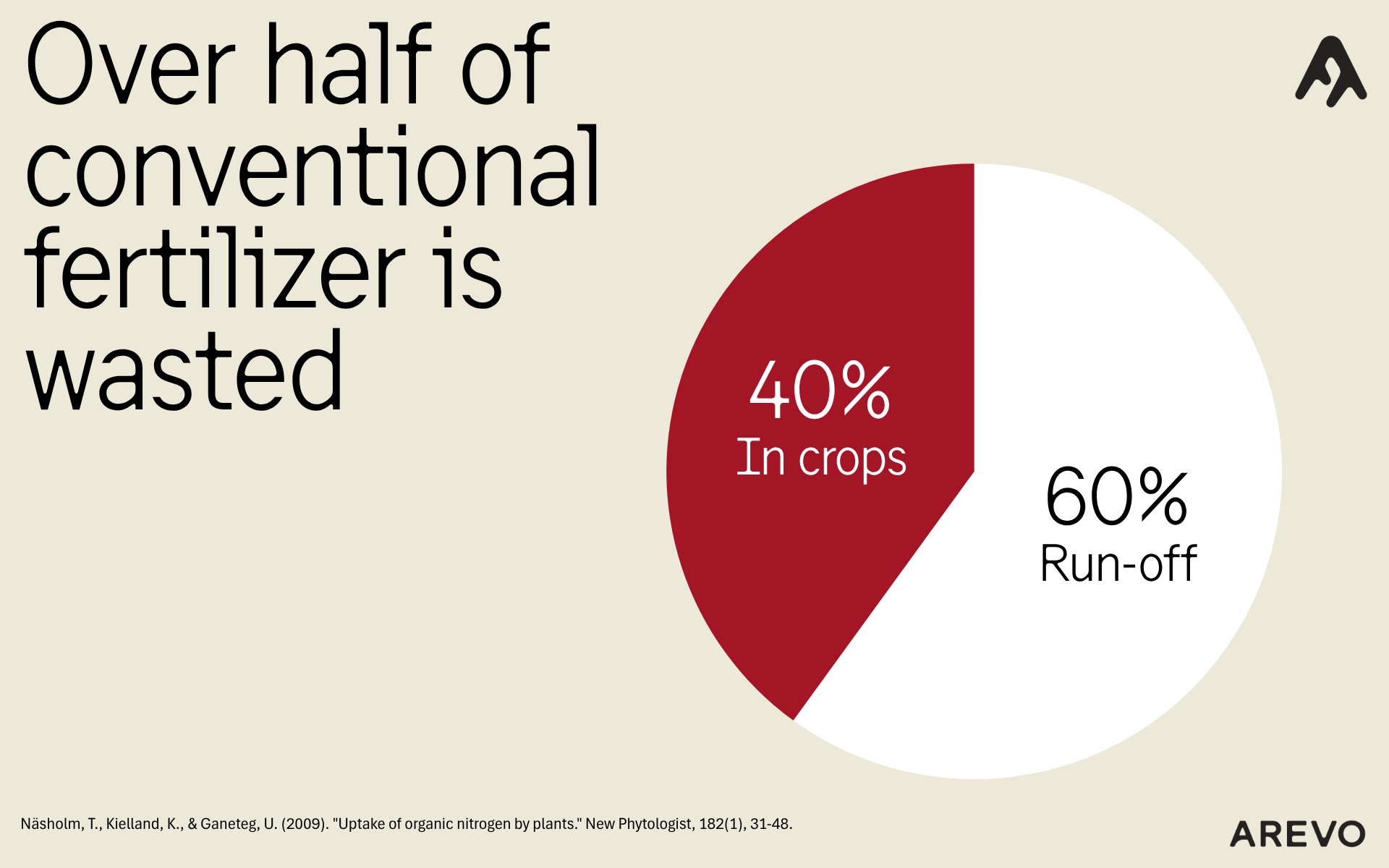
Roughly half, and that number has barely budged in fifty years. A reconstruction of crop yield and nitrogen inputs across 124 countries put global nitrogen use efficiency at about 47% (Lassaletta et al., 2014). More than half of the nitrogen added to cropland is lost to air, water and soil rather than harvested. Put a bag of nitrogen on the ground and you can reasonably expect one half of it to become yield and the other half to become somebody else’s problem.
Where does the missing nitrogen go?
Four exits, all of them driven by nitrate. Nitrate is negatively charged, so soil colloids — also negatively charged — cannot hold it. It travels with water. Rain moves it below the root zone as leaching. Waterlogged pockets strip its oxygen and release it as nitrous oxide and dinitrogen through denitrification. Surface applications lose ammonia to the air by volatilisation. Heavy rain on bare ground takes the rest as runoff. Every one of those losses happens after the nitrogen cycle in soil has already converted your input into its most mobile form.
That is the part worth sitting with. Nitrification is not a leak in the system — it is the system working exactly as designed, turning a nutrient the soil could hold into one it cannot. Ammonium carries a positive charge and binds to clay and organic matter. Within days or weeks of application, soil bacteria convert it to nitrate and that grip is gone. Every kilo you lose after that point was lost by chemistry you paid for.
Can roots feed without waiting for microbes?
Yes — and in forest and grassland soils that is the normal route, not the exception. Soil solution in boreal forest soils is dominated by organic nitrogen, mostly amino acids, and roots absorb it directly (Inselsbacher & Näsholm, 2012). Doing it that way is also cheaper for the plant: taking up nitrogen already bonded to carbon means the crop skips part of the energy bill it would otherwise pay to reduce nitrate inside its own tissue, which lifts carbon use efficiency (Franklin et al., 2016; Tünnermann et al., 2024). Shorter route, lower cost, less to lose.
What does a shorter nitrogen cycle look like in the field?
It looks like nitrogen that stays where you put it, and a crop that is not sprinting to catch it. Skip nitrification and you skip the losses that hang off it — no nitrate to leach, nothing for denitrifying bacteria to strip in a wet pocket, no spike-and-slump feeding pattern to manage with split applications.
Arevo builds Arginex by complexing arginine — a positively charged amino acid — with phosphate. That positive charge binds to soil rather than sliding past it, so nitrogen is released steadily in the root zone instead of racing for the drain. Roots respond by pushing longer hairs and reaching deeper, which widens the surface area doing the feeding. In forest nurseries, feeding seedlings this way cut nitrogen leaching by 80%. Same nitrogen. Different plumbing.
The bottom line
The nitrogen cycle in soil is not broken. The diagram we inherited is. Once you accept that roots can take nitrogen up as an intact molecule, the whole loss chain — nitrification, leaching, denitrification — stops looking inevitable and starts looking optional. That is Root Change: fix the fundamentals at the root zone, and the rest of the season gets easier to steer.
References
Schmidt, S. (2014). Organic nitrogen. New Phytologist. https://arevo.se/en/science-publications-on-plant-nutrient-delivery-system
Eos. (2016). Index suggests that half of nitrogen applied to crops is lost. American Geophysical Union. https://eos.org/articles/index-suggests-that-half-of-nitrogen-applied-to-crops-is-lost
FAO. (2024). New data to measure cropland nutrient budgets. Food and Agriculture Organization of the United Nations. https://www.fao.org/newsroom/detail/new-data-to-measure-cropland-nutrient-budgets/en
Franklin, O. (2016). The carbon bonus of organic nitrogen enhances nitrogen use efficiency of plants. Plant, Cell & Environment. https://arevo.se/en/science-publications-on-plant-nutrient-delivery-system
Inselsbacher, E., & Näsholm, T. (2012). The below-ground perspective of forest plants: soil provides mainly organic nitrogen for plants and mycorrhizal fungi. New Phytologist, 195(2), 329–334. https://arevo.se/en/science-publications-on-plant-nutrient-delivery-system
Lassaletta, L., Billen, G., Grizzetti, B., Anglade, J., & Garnier, J. (2014). 50 year trends in nitrogen use efficiency of world cropping systems. Environmental Research Letters, 9(10), 105011. https://iopscience.iop.org/article/10.1088/1748-9326/9/10/105011
Näsholm, T., Kielland, K., & Ganeteg, U. (2009). Uptake of organic nitrogen by plants. New Phytologist, 182(1), 31–48. https://arevo.se/en/science-publications-on-plant-nutrient-delivery-system
Arevo. (2026). Why textbook nitrogen cycles are outdated. Arevo Knowledge Space. https://arevo.se/en/knowledge-space/why-textbook-nitrogen-cycles-are-outdated-organic-nitrogen-discovery
Arevo. (2026). Arginex and nutrient use efficiency: field, soil and environmental impacts. Arevo Knowledge Space. https://arevo.se/en/knowledge-space/arginex-and-nutrient-use-efficiency-field-soil-and-environmental-impacts
Arevo. (2026). Forest nurseries reduce nitrogen leaching by 80%. Arevo Knowledge Space. https://arevo.se/en/knowledge-space/forest-nurseries-reduce-nitrogen-leaching-80