Mycorrhiza network extends your crops reach and nutrient exchange
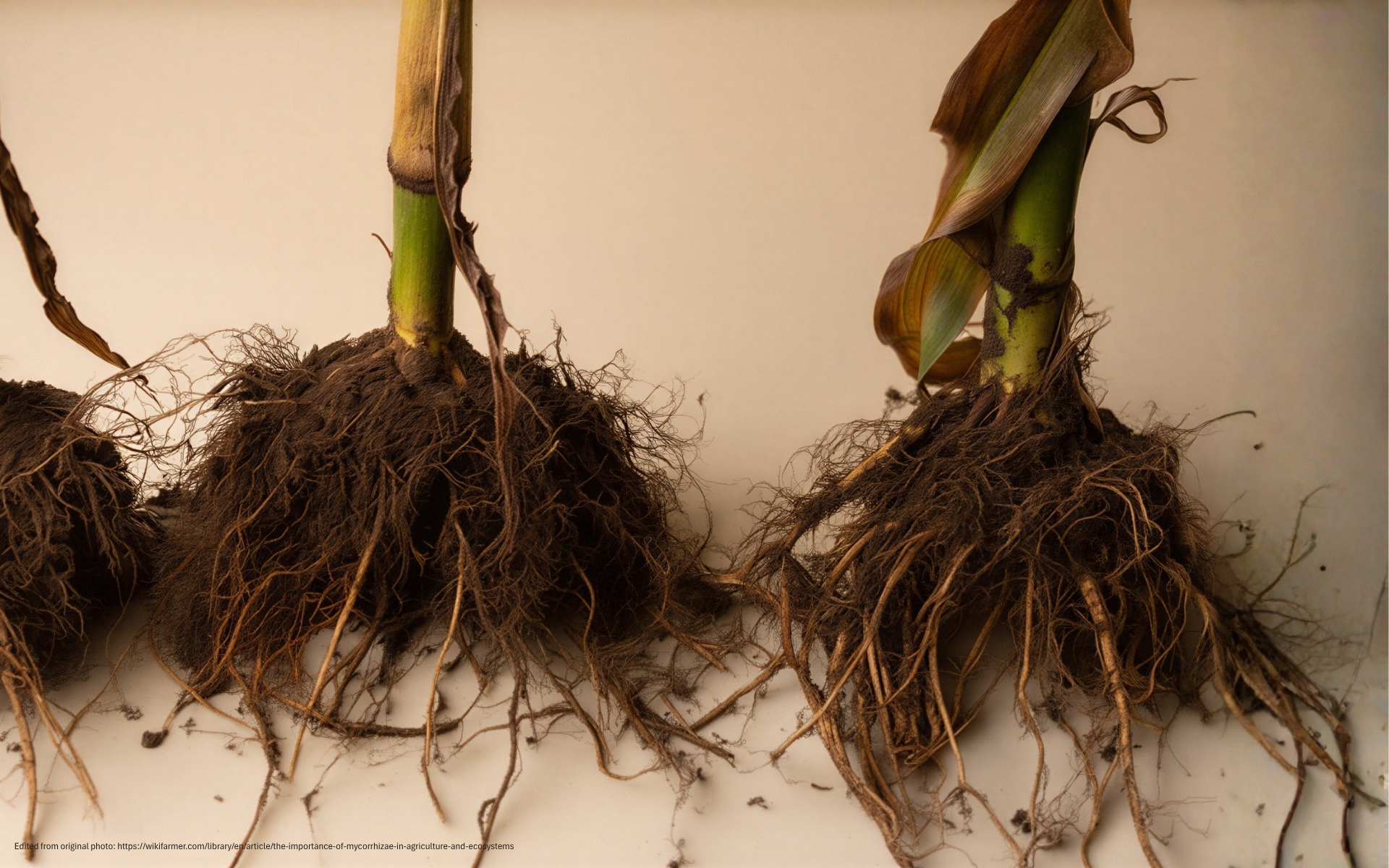
Mycorrhiza network extends your crops reach and nutrient exchange
Most growers have heard the word mycorrhiza. Far fewer have seen what it does.
Under every healthy field, a fungal network is wired into the roots of nearly every crop you grow — extending reach, hauling phosphorus, and trading nutrients for plant carbon. It’s been doing this for 450 million years. And in 2026, with input costs still high and soils still tired, growers can no longer afford to ignore it.
What mycorrhiza actually is
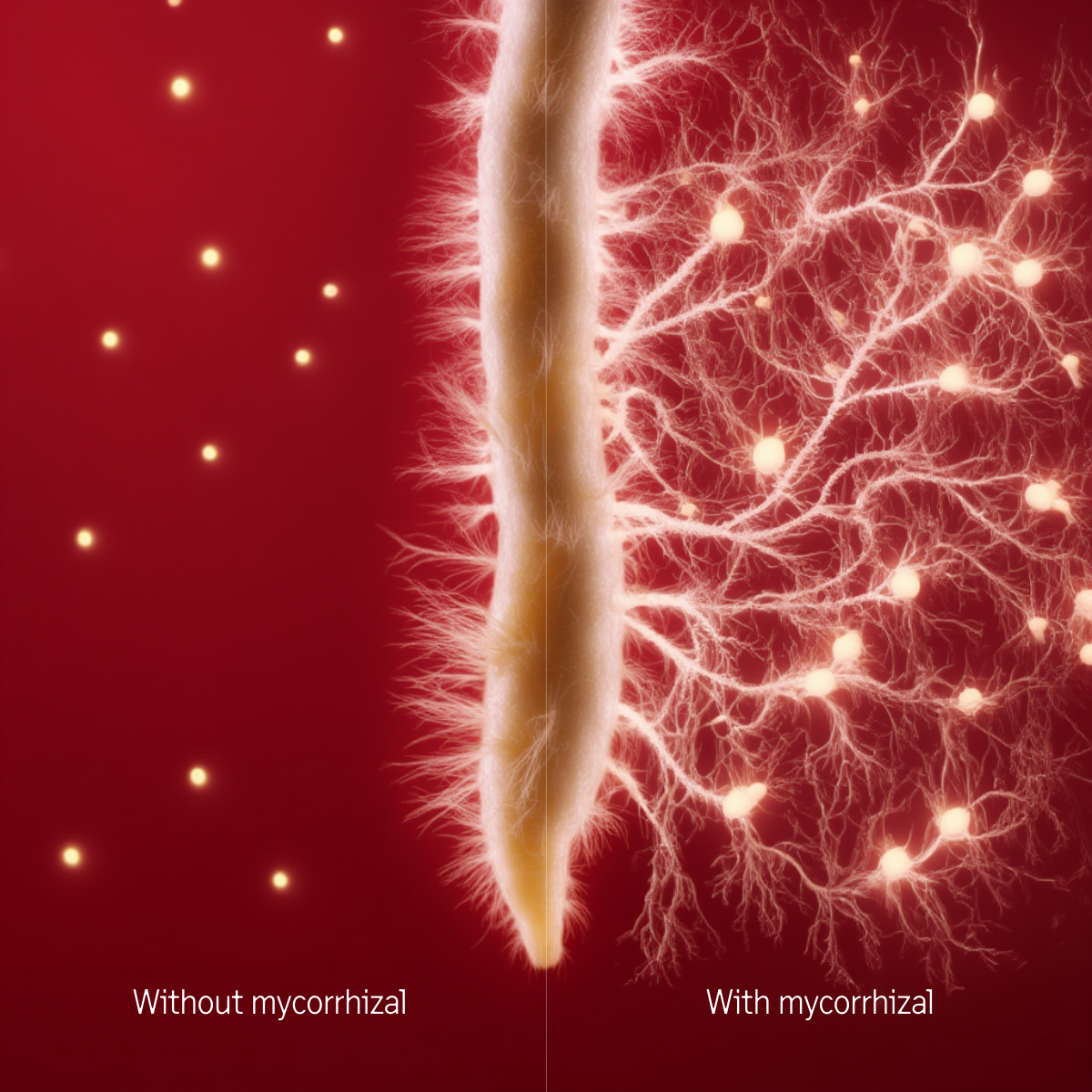
Mycorrhiza means ‘fungus-root.’ It’s a symbiosis between plant roots and soil fungi that’s older than flowering plants themselves. The fungus colonises the root, then sends fine threads — hyphae — out into the soil where roots cannot reach.
The numbers are blunt. The absorptive surface area of a mycorrhizal plant can be up to 50 times bigger than that of a non-mycorrhizal one, with hyphae reaching 4–20 cm beyond the root zone (https://gpnmag.com/article/the-role-of-arbuscular-mycorrhizal-fungi-in-plant-nutrition/). That’s a lot of extra plumbing — built for free, fuelled by the carbon the plant gives back in exchange.
Arbuscular mycorrhizal fungi (AMF) are the type that matter most for arable, vegetable, and tree crops. Around 80% of land plants form this partnership.
Why it matters for yield
Mycorrhiza is best known for moving phosphorus. P is immobile in soil — once a root pulls it from the rooting zone, that pocket is empty. Hyphae reach into the depletion zone the roots have already mined, then keep going.
But the network does more than P. Under favourable conditions, hyphae also help shuttle nitrogen, sulphur, zinc, copper, and water — and they buffer crops against drought by tapping pores too small for root hairs (https://www.sciencedirect.com/science/article/abs/pii/S0176161721002303).
Translate that into the field: stronger early vigour, less dependence on starter P, and crops that handle a dry week without going backwards.
What kills it
The bad news: most of how modern agriculture is practised actively suppresses mycorrhiza. Three habits do most of the damage.
Heavy nitrate applications. When plants are flooded with mineral N, they stop investing carbon in their fungal partner. The relationship goes dormant. The network shrinks.
Tillage. Hyphal networks are physical structures. Pull a plough through them and you tear the wiring apart.
High-phosphorus starter fertilisers. The plant sees the P. It stops trading with the fungus. The partnership collapses.
Add agrochemicals that hammer the wider soil microbiome and you end up with a field that doesn’t grow what nature built it to grow.
How arginine fits
Arevo’s research on organic nitrogen uptake started with a simple observation: plants can absorb intact amino acids straight from the soil (Näsholm et al., 2009). They don’t need every nitrogen atom mineralised by microbes first.
Arginine — the amino acid at the centre of Arginex — works with this biology, not against it. It binds to the soil through its positive charge, releases steadily in the root zone, and doesn’t deliver the nitrate shock that switches the mycorrhizal partnership off.
The result is a nutrient strategy that protects the root network rather than wrecking it. Stronger roots. More hyphae. Healthier soils that keep paying back, season after season.

What this means for your 2026 plan
You don’t have to inoculate to benefit from mycorrhiza. The fungi are almost certainly already in your soil. The question is whether your management is letting them work.
Three moves help, fast. First, cut nitrate-heavy starter blends where you can. Second, move toward slow-release, root-zone-active nitrogen sources that feed the plant without flooding it. Third, give the soil time — reduced-till or no-till practices let hyphal networks rebuild between seasons.
Cover crops help too. A diverse over-winter mix keeps a living root in the soil for more months of the year, giving the fungal partners the carbon they need to stay active. Skip the cover and the network goes quiet.
Every grower has a fungal workforce already on payroll. Stop firing them.
The long view
The mycorrhizal story is a useful reminder that the soil isn’t a passive medium. It’s a living system that either pays you back or doesn’t, depending on how you treat it.
Soil degradation is now visible across 60–70% of European soils (https://environment.ec.europa.eu/topics/soil-health/soil-monitoring-law_en). The EU’s new Soil Monitoring Law, which entered into force in December 2025, will start putting numbers on that. Growers who can show they’re building soil — not mining it — will be the ones who keep their margins, their fields, and their licence to operate.
Mycorrhiza is one of the cheapest measurable wins available. It costs nothing to stop suppressing it.
The root change
Mycorrhiza isn’t a product. It’s a partnership. The systemic shift to crop nutrition that works with biology — not against it — starts at the root zone. That’s where the change happens.
Want the deeper science? Read the Arevo Knowledge Space on mycorrhiza and the hidden network supporting plant nutrition (https://arevo.se/en/knowledge-space/mycorrhiza-the-hidden-network-supporting-plant-nutrition-soil-health-and-yield-stability).
References
Arevo. (2025). Mycorrhiza: The hidden network supporting plant nutrition, soil health and yield stability. Arevo Knowledge Space. https://arevo.se/en/knowledge-space/mycorrhiza-the-hidden-network-supporting-plant-nutrition-soil-health-and-yield-stability
Arevo. (2025). Why textbook nitrogen cycles are outdated — the organic nitrogen discovery. Arevo Knowledge Space. https://arevo.se/en/knowledge-space/why-textbook-nitrogen-cycles-are-outdated-organic-nitrogen-discovery
Greenhouse Product News. (2024). The role of arbuscular mycorrhizal fungi in plant nutrition. https://gpnmag.com/article/the-role-of-arbuscular-mycorrhizal-fungi-in-plant-nutrition/
Hodge, A., & Storer, K. (2021). Plant nitrogen nutrition: The roles of arbuscular mycorrhizal fungi. Plant Physiology and Biochemistry. https://www.sciencedirect.com/science/article/abs/pii/S0176161721002303 Näsholm, T., Kielland, K., & Ganeteg, U. (2009). Uptake of organic nitrogen by plants. New Phytologist, 182(1), 31–48. https://arevo.se/en/science-publications-on-plant-nutrient-delivery-system